Laser Cutting Services: Complete Guide to Process, Materials & Cost
Learn everything about CNC laser cutting services. Explore how fiber laser cutting works, material capacities (MS, SS, Aluminium), cost factors, and benefits.
Laser Cutting Services: Complete Guide to Process, Materials & Cost
Quick Answer: What Is Laser Cutting?
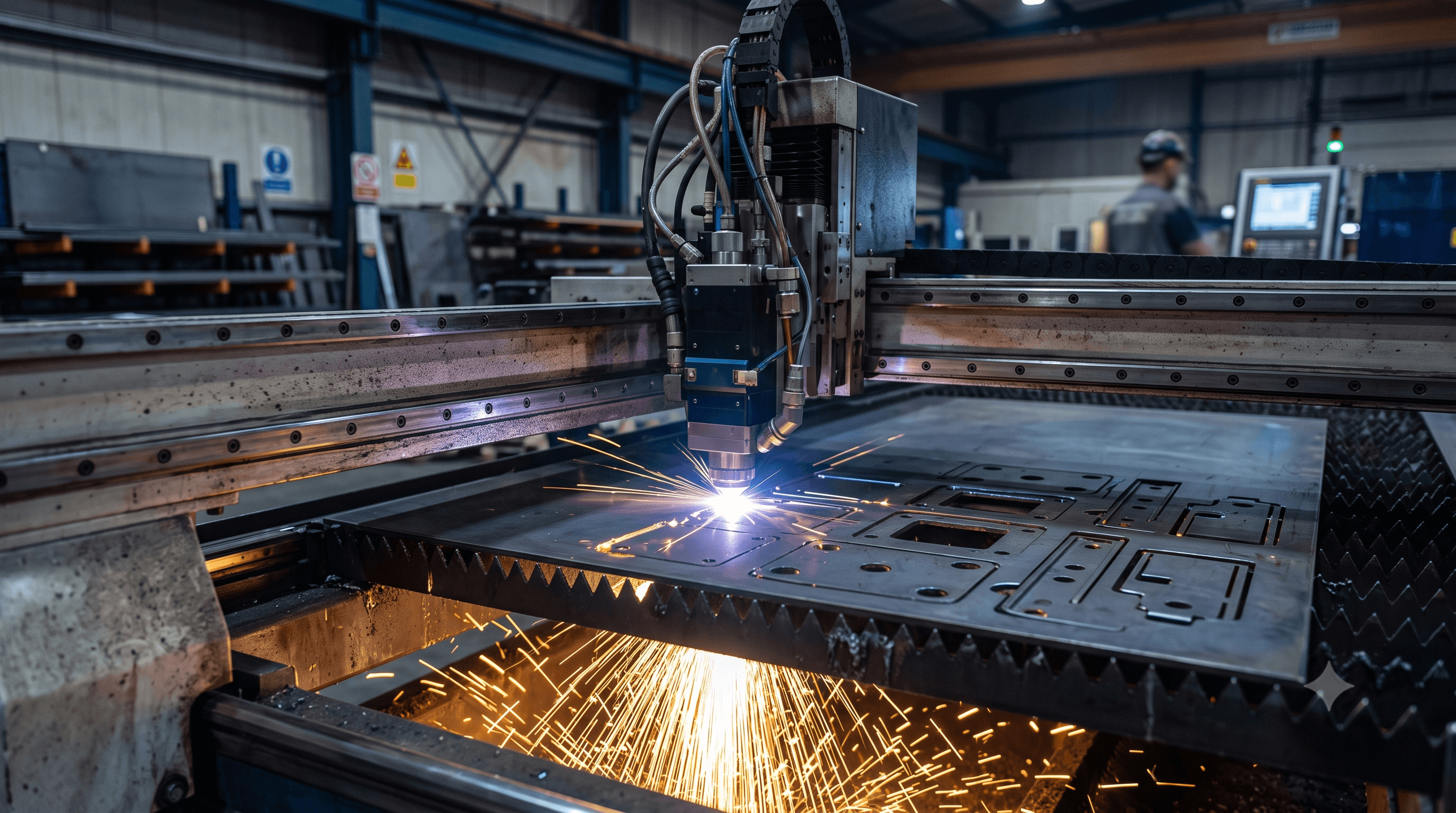
Laser cutting is a computer-controlled (CNC) manufacturing process that uses a focused, high-powered laser beam to melt, burn, or vaporize metal sheets into precise shapes and profiles.
Widely used in sheet metal fabrication, CNC laser cutting services offer high precision, clean edges, complex geometries, and tolerances of up to ±0.1 mm—without requiring expensive custom tooling.
From industrial machinery and electrical enclosures to architectural screens and custom fabrication components, fiber laser cutting provides a fast and efficient route from a digital CAD drawing to a finished metal component.
How Does CNC Laser Cutting Work?
Unlike conventional mechanical cutting, laser cutting is a contactless manufacturing process.
A typical CNC laser cutting workflow involves the following stages:
-
CAD Preparation
The component is designed digitally, typically using DXF, DWG, STEP, or PDF file formats. -
Programming & Nesting
Nesting software converts the drawing into machine instructions while optimizing the arrangement of components on the sheet to reduce material wastage. -
Laser Focusing
The laser cutting machine directs a concentrated beam of light onto the surface of the material. -
Cutting & Assist Gas
The laser follows the programmed cutting path and melts the metal. At the same time, an assist gas—such as oxygen or nitrogen—removes the molten material and creates a clean, narrow cut known as the kerf.
Modern Fiber Laser Technology
Modern fiber laser cutting machines are highly efficient and can process standard metals as well as reflective materials significantly faster than older CO₂ laser systems.
Materials That Can Be Laser Cut
Laser cutting is highly versatile and suitable for a wide range of metals.
However, the maximum practical cutting thickness depends on several factors, including:
- Laser power, typically ranging from 1 kW to 12 kW
- Material type and grade
- Required dimensional tolerance
- Desired edge quality
- Assist gas used
Typical Laser Cutting Capabilities
| Material | Typical Cutting Thickness | Common Applications |
|---|---|---|
| Mild Steel (MS) | Up to 20–25 mm | Brackets, frames, structural panels, heavy machine parts |
| Stainless Steel (SS) | Up to 12–15 mm | Food/pharma equipment, architectural panels, enclosures |
| Aluminium | Up to 10–12 mm | Lightweight automotive parts, electrical panels, aerospace components |
| Galvanized Steel (GI) | Up to 3–4 mm | Ventilation ducts, enclosures, fabricated panels |
| Brass & Copper | Up to 6–8 mm | Decorative screens, electrical switchgear, engineering parts |
Pro Tip:
When requesting a quotation for SS, MS, aluminium, or other metal laser cutting, always specify the exact material grade, sheet thickness, quantity, dimensions, and tolerance requirements.
Key Benefits of Laser Cutting Services
1. High Precision & Accuracy
Laser cutting can achieve dimensional tolerances as tight as ±0.1 mm, making it suitable for components where precise fitting and repeatability are essential.
2. Clean, High-Quality Edges
The narrow heat-affected zone produces smooth and consistent edges, often reducing or eliminating the requirement for secondary grinding and finishing.
3. No Custom Tooling Required
Complex 2D profiles—including:
- Intricate patterns
- Logos
- Slots
- Holes
- Sharp corners
- Custom geometries
can be cut directly from a digital file without the need for expensive dies, punches, or other custom tooling.
4. Efficient Material Utilization
Advanced nesting software arranges components efficiently across the sheet, reducing scrap and maximizing raw-material utilization.
This can significantly lower the cost per component, particularly for bulk production.
5. Fast Turnaround
Laser cutting is highly suitable for:
- Rapid prototyping
- Design iterations
- Small-batch manufacturing
- Repeat production
- High-volume fabrication
Common Applications of Sheet Metal Laser Cutting
Laser cutting is widely used across industrial, commercial, architectural, and engineering applications.
Sheet Metal Fabrication
Common applications include:
- Enclosures
- Base plates
- Chassis
- Covers
- Brackets
- Frames
- Mounting plates
Architecture & Interiors
Laser cutting is commonly used for:
- Custom jali designs
- Decorative metal screens
- Building facades
- Railings
- Signage
- Interior partitions
Automotive & Machinery
Typical applications include:
- Engine components
- Exhaust parts
- Machine guards
- Structural components
- Internal frames
- Equipment panels
Electrical & Electronics
Laser-cut components are extensively used for:
- Switchgear parts
- Control panels
- Electrical enclosures
- Cable-management systems
- Equipment cabinets
Laser Cutting Cost: What Affects the Price?
Laser cutting cost is generally determined by a combination of raw material cost, machine time, cutting complexity, and production quantity.
Key Factors Affecting Laser Cutting Price
Material Type & Thickness
Thicker and harder materials generally require:
- Higher laser power
- Slower cutting speeds
- Greater gas consumption
- Longer machine time
As a result, cutting costs generally increase with material thickness.
Cutting Length & Complexity
Intricate designs containing:
- Thousands of small holes
- Detailed patterns
- Long cutting paths
- Multiple internal profiles
require additional machine time and may increase the overall cutting cost.
Order Quantity
Higher production quantities generally reduce the per-piece cost because of:
- Better material nesting
- Reduced setup time per component
- Improved machine utilization
- Economies of scale
Assist Gas Used
The choice of assist gas can materially affect cost.
For example, nitrogen cutting, which is commonly used for producing clean, oxide-free edges on stainless steel and aluminium, is generally more expensive than oxygen-assisted cutting.
Material Supply
Pricing will also depend on whether:
- The customer supplies the raw material, or
- The laser cutting manufacturer procures the material.
How to Choose the Right Laser Cutting Service Provider
Choosing the right fabrication partner can significantly affect product quality, cost, and turnaround time.
Consider the following factors:
High Machine Capability
Confirm that the service provider's:
- Laser power
- Cutting capacity
- Machine bed size
- Material capability
are suitable for your required material and thickness.
CAD & Design Support
A competent laser cutting service provider should be able to assist with:
- DXF/DWG preparation
- Design optimization
- Nesting
- Tolerance review
- Manufacturability improvements
Optimizing the CAD file before production can improve cutting quality while reducing material wastage.
End-to-End Fabrication Capability
Where possible, choose a provider that offers multiple fabrication processes under one roof, such as:
- Laser cutting
- Sheet bending
- Welding
- Grinding
- Powder coating
- Finishing
- Assembly
This can reduce vendor coordination, logistics costs, production delays, and quality-control issues.
Laser Cutting Services from Jai Shree Perforator
At Jai Shree Perforator, we provide comprehensive metal-processing and fabrication solutions.
Alongside our range of:
- Perforated sheets
- Expanded metal mesh
- Welded wire mesh
we also offer precision laser cutting services for customized sheet metal components.
Whether you require:
- Heavy-duty MS brackets
- Detailed architectural stainless steel screens
- Lightweight aluminium enclosures
- Customized sheet metal profiles
- Industrial fabrication components
our team can assist with your requirements.
Request a Laser Cutting Quotation
For an accurate quotation, simply share:
- Your CAD drawing
- Material type and grade
- Sheet thickness
- Required quantity
- Dimensional tolerances
- Finishing requirements, if any
Frequently Asked Questions (FAQs)
Q1. What is laser cutting used for?
Laser cutting is used to create precise shapes and profiles from metal sheets.
Common applications include:
- Sheet metal fabrication
- Industrial machinery
- Automotive components
- Architectural jali screens
- Signage
- Electrical enclosures
- Custom fabrication components
Q2. How thick can a CNC laser cut?
The cutting capacity depends primarily on the laser's power and the material being processed.
Typical fiber laser capabilities may include:
| Material | Typical Maximum Thickness |
|---|---|
| Mild Steel | 20–25 mm |
| Stainless Steel | 12–15 mm |
| Aluminium | 10–12 mm |
Actual cutting capacity may vary depending on the machine, material grade, assist gas, and required edge quality.
Q3. How accurate is laser cutting?
CNC laser cutting is highly accurate and can typically achieve dimensional tolerances of around ±0.1 mm, while producing clean and consistent edges.
Q4. What file format is needed for laser cutting?
The most commonly used file formats for 2D laser cutting are:
- DXF
- DWG
Many laser cutting service providers can also work with:
- STEP
These files may first be converted into a suitable CAD format before production.
Q5. Is laser cutting expensive?
Laser cutting can be highly cost-effective because it does not require custom dies or tooling.
The final cost generally depends on:
- Material type
- Material thickness
- Cutting length
- Design complexity
- Machine time
- Quantity
- Assist gas
- Material utilization
Advanced nesting software also helps reduce raw-material wastage, making laser cutting particularly economical for repeat and bulk orders.
Q6. What is the difference between fiber laser and CO₂ laser cutting?
Fiber lasers use a solid-state laser source and are generally faster and more energy-efficient when cutting metals.
They are particularly effective for cutting reflective materials such as:
- Aluminium
- Brass
- Copper
Older CO₂ laser systems may be less efficient when processing these reflective metals.
For modern sheet metal fabrication, fiber laser cutting is therefore widely preferred for its speed, efficiency, precision, and versatility.